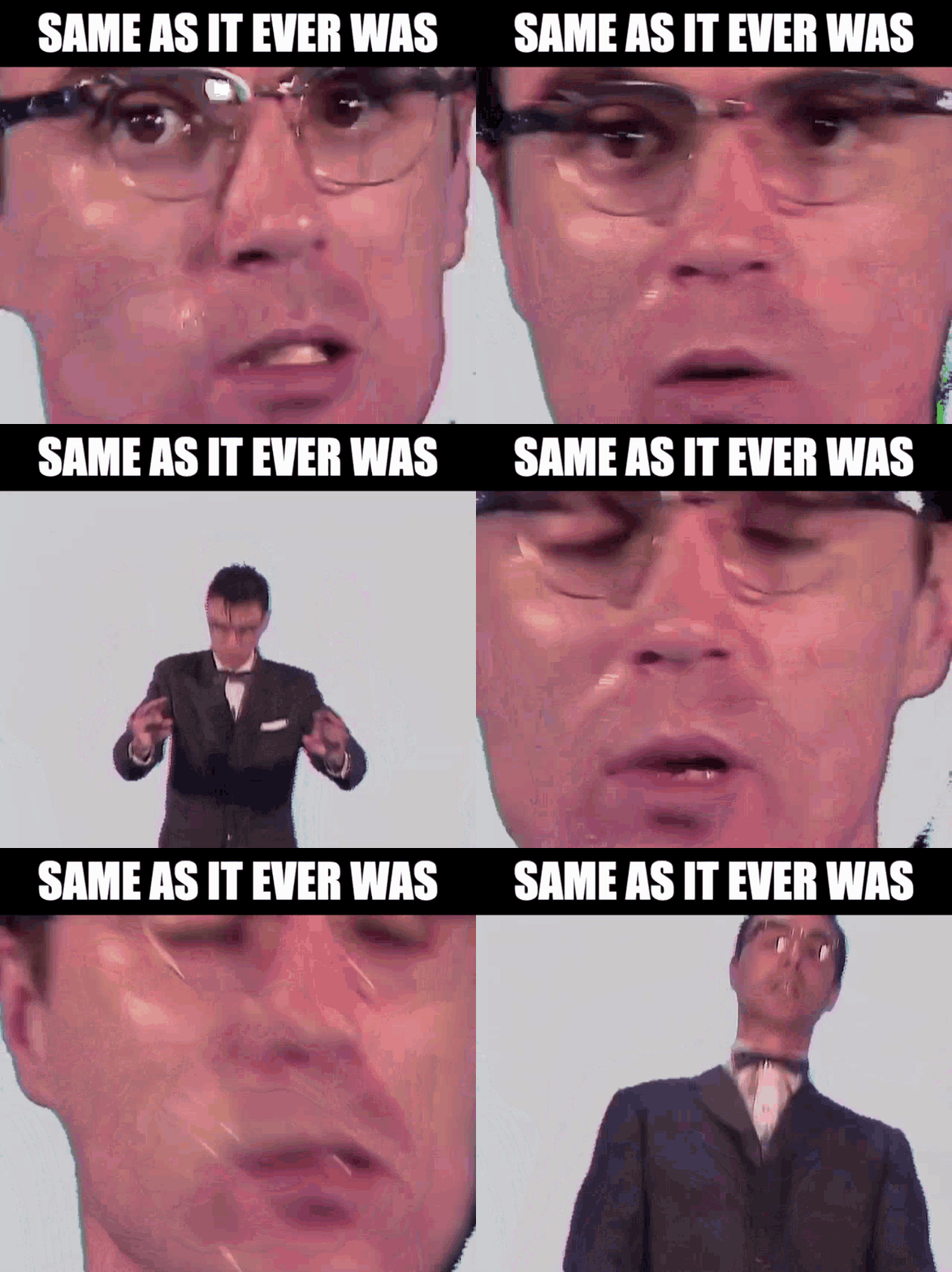
Same As it Ever Was ♾️


Overthinking has killed more startups than competition ever will.
I’ve seen it time and time again, agnostic to any specific industry.
They don’t die from bad ideas.
They die from overthinking good ones.
There’s a moment in their trajectory where momentum slows… then stalls… then disappears.
Not because the team ran out of ideas. Not because the market disappeared.
Because no one pulls the trigger.
So when things feel uncertain, the default move is familiar.
Gather more data. Talk to more users. Refine the idea. Tighten the strategy.
That feels responsible. It feels like momentum.
But there’s a line most teams don’t see in real time.
On one side, analysis sharpens decisions. On the other hand, it quietly replaces them.
The work still looks impressive from the outside.
Calendars fill up. Notion docs multiply. Decks get sharper.
But nothing meaningful is actually changing.
Same as it ever was.
The real reason no one pulls the trigger
It’s not laziness.
It’s the weight of being wrong.
It’s Paralysis by Analysis.
Shipping forces a verdict. The market responds. And suddenly, the idea isn’t protected anymore. It either works—or it doesn’t.
So teams drift toward the safest version of progress: thinking.
Where everything still has potential. Where nothing has been disproven.
Where the story still holds.
This is where the Sunk Cost Fallacy creeps in

The longer you stay in analysis, the more you invest.
Not just money.
Time. Energy. Identity.
And those investments don’t sit quietly. They start influencing decisions in ways that feel logical in the moment—but aren’t.
That’s the sunk cost fallacy doing exactly what it’s designed to do.
Time: the silent anchor

“We’ve already spent months on this.”
Time carries weight.
Late nights. Effort. Opportunity cost.
So instead of stepping back, teams start trying to justify it.
The question shifts from:
“Is this still right?”
to:
“How do we make this worth it?”
Ideas: when thinking becomes identity

At the beginning, it’s just a concept.
Then it becomes your thing.
And without realizing it, the idea stops being flexible.
Feedback gets filtered. Weak signals get reinterpreted. Teams adjust around the edges instead of questioning the core.
Not because it’s right.
Because it’s theirs.
Money: the amplifier

Once money is involved, everything tightens.
Now every decision carries pressure.
So instead of asking what’s best from here, teams try to recover what’s already been spent.
They double down.
This isn’t related to the potential upside.
Once again, that’s the sunk cost fallacy doing exactly what it’s designed to do.
They double down because walking away feels worse, and thus the spiral begins.
Enter The Doom Loop

This is how it plays out in real life:
Uncertainty leads to more analysis.
Analysis delays action. Delay increases investment. Investment builds attachment.
Attachment resists change. Resistance creates more analysis.
From the inside, it feels like careful thinking.
From the outside, nothing is happening. 🌀
Paralysis by analysis.
This isn’t theoretical. It’s already happened before.
Remember Friendser?
Probably not, but they had it first.
Before MySpace. Before Facebook.
They had the users. The growth. The network effect most startups chase.
Then the product started to strain under its own success.
Pages slowed down. The experience broke in small but noticeable ways.
Users felt it before the company fully reacted.
Inside the company, the response was thoughtful.
Engineers debated architecture.
Leadership weighed long-term fixes against short-term patches.
There was a real desire to solve the problem properly.
So they paused to figure it out.
And while they were figuring it out, time kept moving.
They had already invested heavily in their infrastructure, so changing direction wasn’t simple. Every fix had to account for what already existed.
The question quietly shifted from speed to preservation.
Meanwhile, the market moved.
MySpace kept shipping, even if it was messy. Users didn’t care that it was imperfect. They cared that it worked and evolved.
Facebook entered with a narrower focus and a faster loop, quickly building, releasing, and learning in public.
By the time Friendster made meaningful progress, user behavior had already changed.
The momentum was gone.
They didn’t lose in a single moment.
They lost gradually… then all at once.
What’s really being lost

Not time. Not money.
Learning.
Startups don’t win because they think better.
They win because they learn faster than everyone else.
And learning only happens when something real meets the real world:
A product in users’ hands. A decision with consequences. A signal you didn’t control.
Analysis can prepare you.
It can’t replace that.
The shift that changes everything
The founders who break out of this don’t suddenly gain better insight.
They change how they move.
They shorten decision cycles. They treat ideas as hypotheses.
They detach from what’s already been spent.
And they come back to one question:
If we were starting today, would we still choose this path?
If the answer is no, they adjust.
Quickly.
Without needing to justify the past.
Shipping is the unlock
There’s no version of planning that removes uncertainty.
At some point, the only way forward is to act.
Shipping creates clarity. It exposes weak assumptions and forces real feedback.
It replaces internal debate with external signals.
More importantly, it restores momentum.
And momentum is what most stuck startups are actually missing.
See you next week. ♾️
Available Now ♾️ Shipping Globally
Join the Web3Weekly ♾️ Professional Learning Network